Filing Workflow
The TaxBandits API supports three approaches to 1099 filing, allowing you to choose the workflow that best fits how your platform collects, stores, and submits payer, recipient, and payment information. Some platforms prefer to submit completed 1099 data in a single request. Others may collect payer and recipient details first, add payment data over time, and file only when the records are ready.
Choose the approach that fits how your platform manages payment data.
- Automate the end-to-end 1099 compliance cycle
- Record transactions throughout the year, generate 1099s at year-end
- Create and file 1099s directly
Approach 1 — Automate the end-to-end 1099 compliance cycle
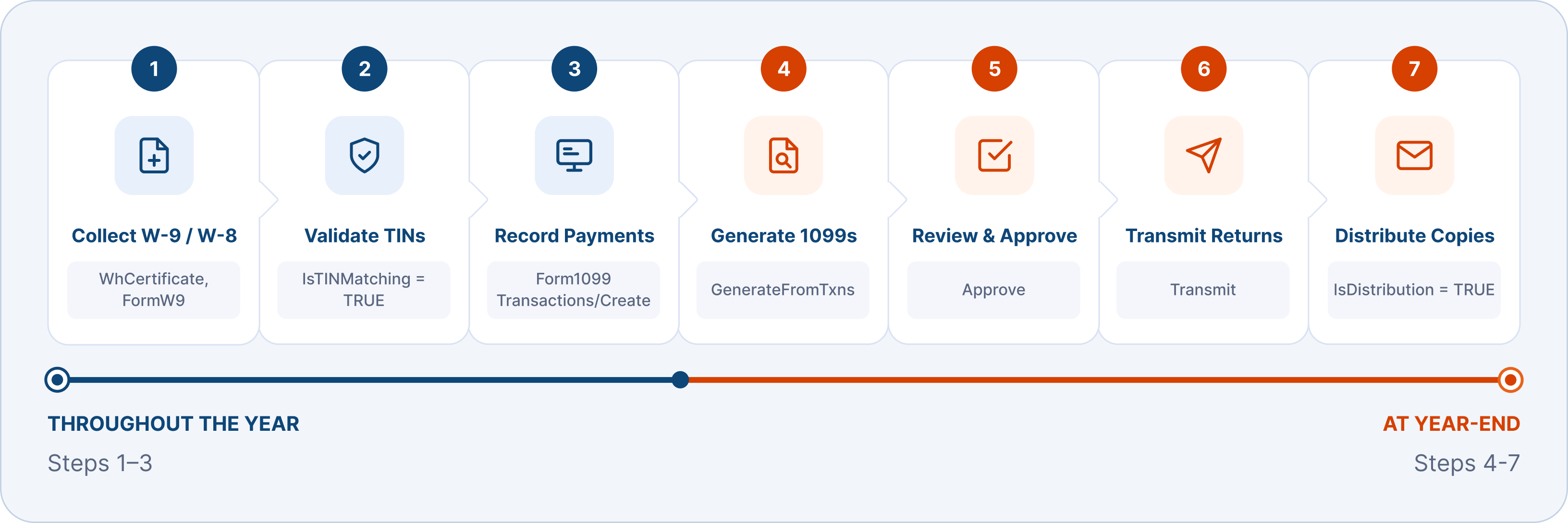
Collect W-9/W-8 forms from recipients, validate their TINs against the IRS database, record transactions as payments occur throughout the year, then generate and file 1099 forms at year-end, all within the same API integration.
This is the most complete approach, covering the full compliance lifecycle from recipient onboarding through to IRS/state filing and recipient copy distribution.
Best for: Vendor management platforms, contractor payment platforms, gig marketplaces, AP automation tools, and other systems that require recipient tax details before payments are made.
How this workflow works
- Collect recipient tax information: Use
WhCertificate,FormW9to collect W-9/W-8 information from recipients during onboarding. - Validate recipient TINs: Set
IsTINMatchingto TRUE to validate recipient TINs against IRS records. - Record payments as transactions: Use
Form1099Transactions/Createto post each payment as it occurs throughout the year. - Generate 1099 records from transactions: At year-end, call
GenerateFromTxnsto aggregate eligible transactions and create 1099 return records automatically. - Review and approve generated records: Call
Approveto confirm the generated 1099 records before filing. - Transmit the returns: Call
Transmitto submit the approved returns to the IRS. - Distribute recipient copies: Set
IsDistributionto TRUE to trigger postal mailing or online access for recipient copies, based on the distribution option selected.
Approach 1 — Automate the end-to-end 1099 compliance cycle
Collect tax forms, validate TINs, record payments, then generate and file 1099s in one connected workflow.
Vendor management platforms, contractor payment platforms, gig marketplaces, and AP automation tools.
Approach 2 — Record transactions throughout the year and generate 1099s at year-end
Use this approach when recipient tax information is already available in your platform or collected through a separate onboarding process. Instead of collecting W-9/W-8 forms through TaxBandits, you can directly record payments as transactions throughout the year.
Best for: Gig platforms, freelance marketplaces, affiliate payout systems, and other platforms where recipient details are already collected before payments are made.
How this workflow works
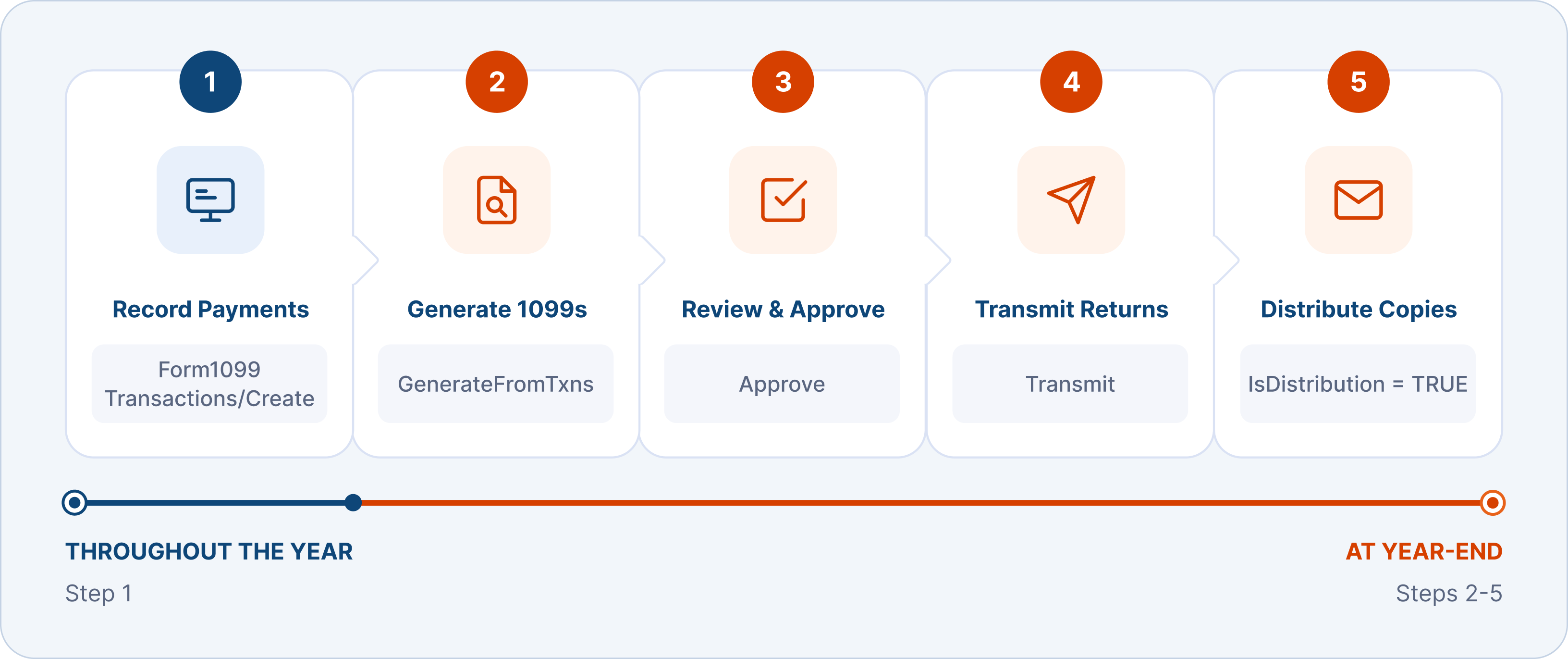
- Record payments as transactions: Use
Form1099Transactions/Createto post each qualifying payment as it occurs. Include theBusinessId,RecipientIdorPayeeRef, payment amount, and form type. - Generate 1099 records from transactions: At year-end, call
GenerateFromTxnsfor the applicable form type. The API aggregates transactions by recipient and creates 1099 return records for eligible recipients. - Review and approve generated records: Call
Approveto review and confirm the generated 1099 records before filing. - Transmit the returns: Call
Transmitto submit the approved returns to the IRS. - Distribute recipient copies: Set
IsDistributionto TRUE to trigger postal mailing or online access for recipient copies, based on the distribution option selected.
Approach 2 — Record transactions throughout the year and generate 1099s at year-end
Use existing recipient data, record payments during the year, then generate 1099s automatically at year-end.
Gig platforms, freelance marketplaces, and affiliate payout systems.
Approach 3 — Create and file 1099s directly
Use this approach when your platform already maintains recipient information and accurate annual payment totals in your own system. Instead of posting transactions throughout the year, you can create 1099 return records directly using the final year-end totals.
This approach is ideal for platforms that already calculate reportable compensation internally and only need TaxBandits to validate, create, transmit, and distribute the 1099 forms.
Best for: Payroll software, accounting platforms, HCM tools, and other systems that already track annual contractor payment totals and need a direct filing workflow at year-end.
How this workflow works
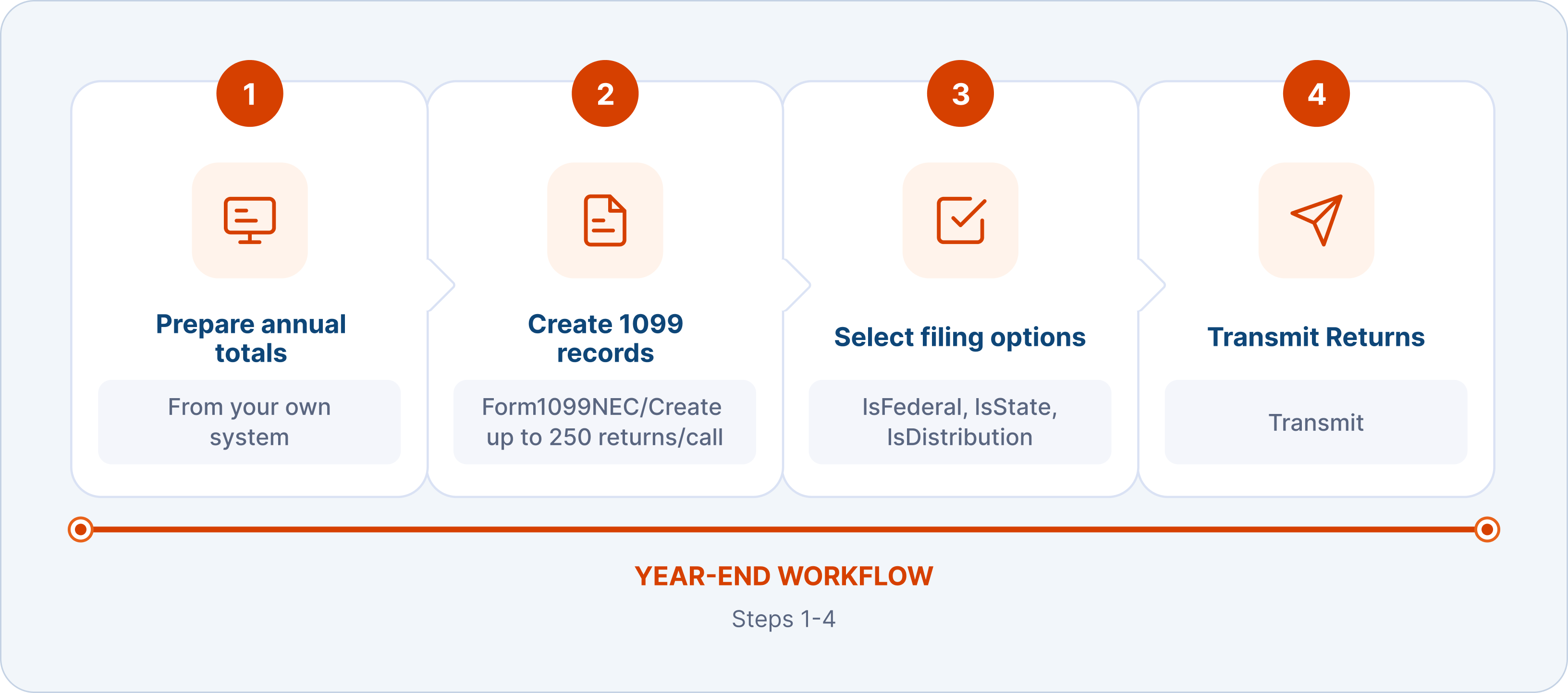
- Prepare annual payment totals: Calculate the total reportable payment amount for each recipient from your own system.
- Create 1099 return records: Call
Form1099NEC/Createor the equivalent endpoint for the applicable form type. Pass payer, recipient, payment amount, and filing details in the request. A singleCreaterequest can include up to 250 return records. For larger volumes, split records into multiple submissions and track eachSubmissionIdseparately. - Select filing and distribution options: Use
IsFederal,IsState, andIsDistributioninReturnManifestto enable federal filing, state filing, and recipient copy distribution as needed. - Transmit the returns: Call
Transmitto submit the approved returns to the IRS.
Approach 3 — Create and file 1099s directly
Use annual payment totals from your own system to create and file 1099 returns directly.
Payroll software, accounting platforms, and HCM tools.
Filing services
When creating a 1099 return using any of the three approaches above, opt into at least one of the following filing services inside ReturnManifest. Services set at the submission level apply to all returns in that call. To apply different services to specific recipients, override the flags at the record level inside ReturnData.
Federal and state filing
- Federal e-filing: Set
IsFederalTRUE. Transmits the return to the IRS electronically. - State e-filing: Set
IsStateto TRUE. TaxBandits routes the state copy through CF/SF or direct state e-file based on the recipient's state and form type — no additional routing configuration required. - State-only filing: Set
IsStateto TRUE andIsFederalto FALSE. Use this when the federal return has already been submitted through another system and only the state filing is needed.
Recipient copy distribution
- Postal mailing: TaxBandits prints and mails the recipient copy. Set
DistributionTypeto POSTAL_ONLY or POSTAL_AND_ONLINE. - Online access: TaxBandits emails the recipient a secure link to access and download their form digitally. Set
DistributionTypeto ONLINE_ACCESS or POSTAL_AND_ONLINE. The recipient'sEmailfield is required.
Schedule filing
Scheduled filing allows you to create 1099 return records now and transmit them to the IRS on a specific future date. This is useful when your platform prepares filings in advance but wants to control when the returns are submitted.
Key points
- Schedule the transmission: Set
ScheduleFilingTRUE and provide anEFilingDateinsideScheduleFiling. - Use a valid future date: The
EfileDatemust be a future date and must be on or before the IRS e-file deadline for the applicable form type. - Update the schedule before transmission: Scheduled submissions can be updated before the scheduled transmission date, including changing the
EfileDate, using theUpdateendpoint. - Override the schedule when needed: Calling
Transmitmanually on a scheduled submission overrides the scheduled date and submits the return immediately.
Example: A tax software platform prepares 1099-NEC filings for 800 employer clients during the first week of January. Instead of transmitting immediately, the platform schedules the submissions for January 28, a few days before the January 31 IRS deadline.
This gives the platform time to review records, coordinate with clients, and resolve issues before the deadline. If a client needs to file earlier, the platform can call Transmit manually to submit that client’s return immediately.