E-file Status Change (Federal)
This webhook provides real-time updates on the processing status of tax forms filed with federal agencies such as the IRS or SSA. This includes forms like 1099, W-2, 94x, ACA, and other form types supported by TaxBandits.
This event type also applies to correction filings.
Steps to configure
-
Log in to Developer Console
Navigate to ‘Settings’ → ‘Webhook Notifications’. -
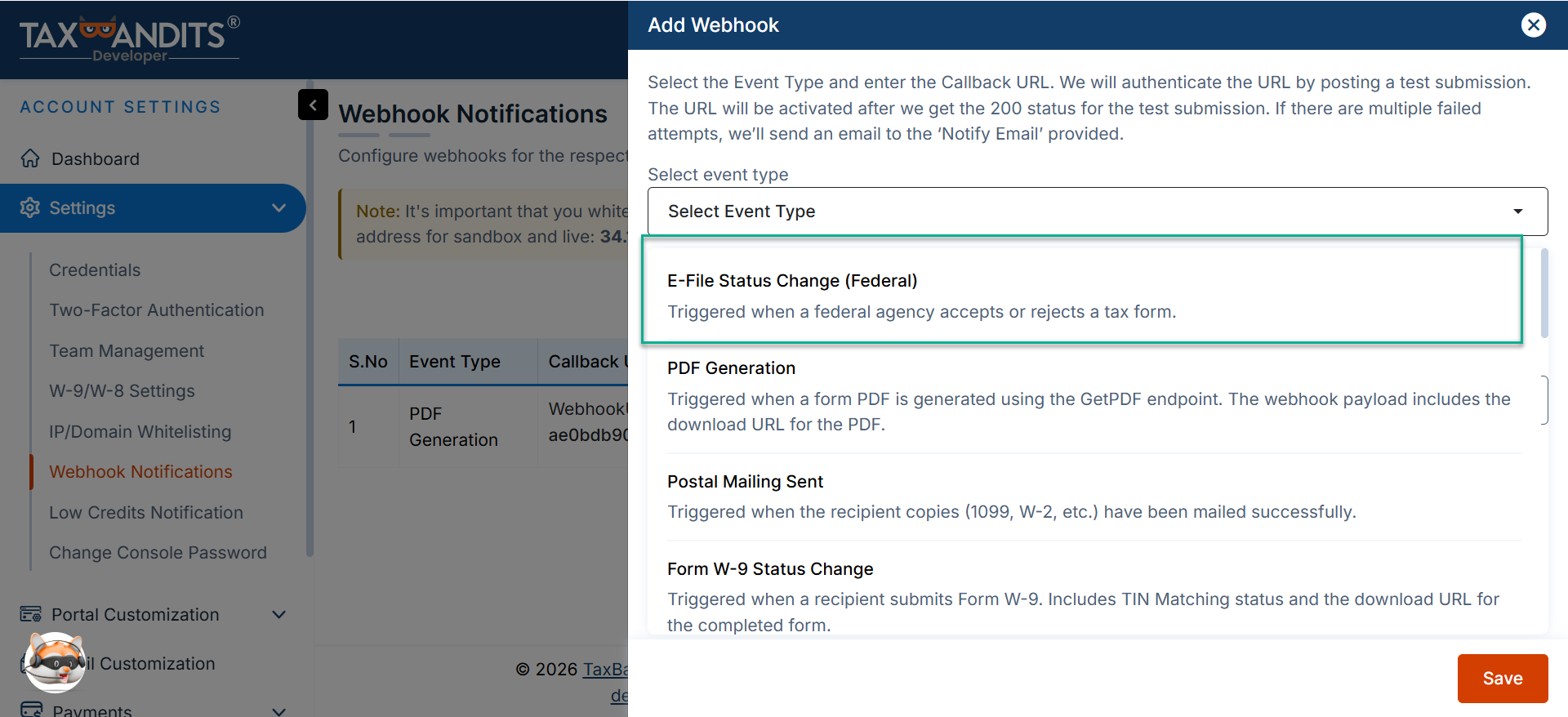
Add a webhook
Click ‘Add Webhook’ and select the event type ‘E-file Status Change (Federal)’.
-
Provide a callback URL
Enter a valid HTTPS callback URL (maximum 500 characters). Ensure that your callback URL follows these best practices.- The API validates this URL by sending a sample JSON payload.
- The webhook will be activated only after your endpoint responds with an HTTP 200 status code.
-
Configure a notification email
Provide a notification email address. TaxBandits will use this email to alert you if webhook delivery attempts fail.
Statuses available
The following are the different status codes available for tax forms filed with the federal agency.] For W-2 and 1099 forms:
- Sent to Agency – The form has been transmitted and is awaiting acceptance or rejection
- Accepted – The form has been accepted by the IRS/SSA
- Rejected – The form has been rejected. Fix the errors and retransmit
- ACCEPTEDWITHERRORS – The form was accepted with validation issues, and a correction must be filed
- Yet_to_Retransmit – Updates have been made to the rejected form, and it is pending retransmission to the IRS/SSA
For 94x forms
- Accepted – The form has been accepted by the IRS
- Rejected – The form has been rejected. Fix the errors and retransmit
Receiving webhook requests
Once the webhook is configured and the callback URL is successfully authenticated, TaxBandits will send an HTTP POST request to your callback URL whenever a filing status changes.
Each request contains a JSON payload with submission details and record-level status information.
Sample webhook payload – 1099 e-file status change
{
    "SubmissionId": "b870040d-fded-420b-b424-28bf0dd11261",
    "FormType": "FORM1099NEC",
    "Records": [
        {
            "RecordId": "5e2433ef-0d2e-4d8d-beba-06dac739a9fc",
            "RecipientId": "144b9ab4-d5a3-4d9c-bee1-4838e006e23b",
            "PayeeRef": "Payee001",
            "AccountNum": "123456",
            "Status": "Accepted",
            "StatusCode": 14,
            "FilingReference": null,
            "StatusTime": "2023-12-06T07:45:17.9647302-05:00",
            "RejectedBy": null,
            "Errors": null
        },
        {
            "RecordId": "5e2433ef-0d2e-4d8d-beba-06dac739a9fc",
            "RecipientId": "7a7d932b-de8d-41c4-a1f6-ff84cfe08775",
            "PayeeRef": "Payee002",
            "AccountNum": "213125",
            "Status": "Rejected",
            "StatusCode": 15,
            "FilingReference": null,
            "StatusTime": "2023-12-06T07:45:17.9647302-05:00",
            "RejectedBy": null,
            "Errors": [
                {
                    "Id": null,
                    "Code": "ERR-SAMPLE-001",
                    "Name": "Sample Field",
                    "Message": "Sample Error Message",
                    "Type": "Error"
                }
            ]
        }
    ]
}
Sample webhook payload – Form 941 e-file status change
{
"Submissionld": "95a762b7-3a46-4b42-aa6c-ddac664cc95c",
"PayerRef": "Payer-1403-06",
"FormType": "Form941",
"Records": [
    {
    "Recordld": "6ec62ba9-6d8a-4c89-9106-023c862bfl4c",
    "Recipientld": null,
    "PayeeRef": null,
    "AccountNum": null,
    "Status": "Accepted",
    "StatusCode": 14,
    "FilingReference": {
        "FiledWith": "1RS",
        "RefNumber": "32133920250733204005",
        "ApprovalLetterPath": "https ://expressirsforms.s3.amazonaws.com/TempApprovalLetters/121762/6ec62ba9-6d8a-4c89-9106-023c862bf14c.pdf",
        "ElectronicPostMark": "2025-03-14T06: 36:39.027-04:00"
    },
    "StatusTime": "2025-03-14T06:39:57.6043399-04:00",
    "RejectedBy": null,
    "Errors": null
    }
]
}
Responding to webhook requests
Your application must respond with HTTP 200 OK to acknowledge receipt of a webhook request.
- Any response other than 200 is treated as a failed delivery
- HTTP redirects (301) are not supported and are treated as errors
- Your endpoint must respond within 5 seconds, or the request is considered a timeout
If a webhook delivery fails or times out, TaxBandits will retry the request up to 9 times within 24 hours.
Validating webhook requests
Before processing a webhook payload, you must verify that the request originated from TaxBandits.Refer to the Webhook validation documentation to learn how to authenticate incoming webhook requests.