1099 API vs Manual Filing- The Hidden Costs You Can't Ignore

A no-fluff breakdown for finance teams, accountants, and business owners who file at scale
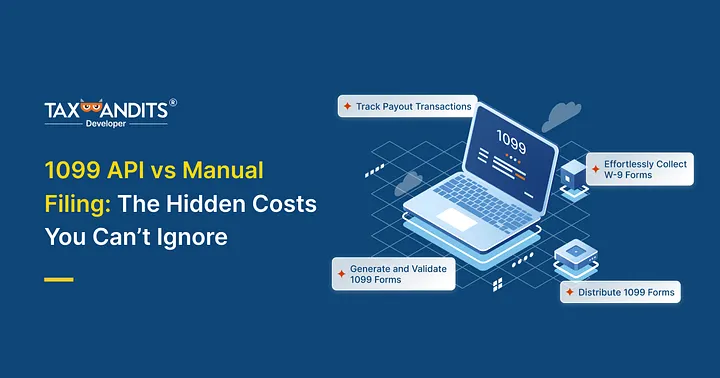
Every January, the same fire drill plays out across accounting platforms: someone exports a CSV, reformats it for a government portal, uploads it, fixes schema errors, and manually validates the output. Maybe it's your customers doing this inside your product. Maybe it's your internal team. Either way, it's expensive — and most of that cost never shows up on a line item.
But here's what most platforms get wrong: the 1099 cost problem doesn't start in January. It starts the moment you onboard a new contractor or vendor. By the time filing season arrives, the errors — and the costs that come with them — are already baked in.
A Practical Starting Point
If you're evaluating a move to 1099 API, start by auditing last year's filing season:
- How many hours did your team spend on 1099 preparation and filing?
- Did you receive any IRS B-notices or penalty letters?
- Did any recipients report not receiving their copies?
- Did you file in all required states?
- Did you file everything on time?
If the answer to any of those last four questions is uncertain, you already have your answer.
Two Architectures, Very Different Outcomes
Before we get into costs, let's be precise about what we're comparing.
Manual filing means human-operated portals — the IRIS (Information Returns Intake System), state agency portals, or third-party web apps. Data gets exported from source systems, cleaned, reformatted, and uploaded. Errors come back as a separate status response that someone has to interpret and fix manually.
API-based filing means your system POSTs a JSON payload to a filing service. The API handles validation, IRS submission via IRIS, e-delivery to recipients, state routing, and async status callbacks. Your users never leave your product to file.
For a software provider, this means 1099 compliance lives inside your product. Your customer never has to leave to file. You own the workflow end-to-end.
The Hidden Cost Layers in the 1099 Cycle
The 1099 compliance cycle has four stages. Manual handling at each one carries a distinct, quantifiable cost. Here's what that looks like — and what replacing it with an API-driven workflow actually saves.
Stage 1: W-9 Collection
Before a single 1099 is filed, you need a valid W-9 from every payee — legal name, TIN, entity type, and address. In practice, W-9s arrive as email attachments, paper scans, or not at all. AP teams chase them down manually at year-end when it's too late to fix anything cleanly.
The real costs
-
Staff time: Chasing, logging, and manually transcribing W-9 data from PDFs runs 2–4 hours per 50 vendors — at scale, this compounds fast.
-
Data entry errors: Manual transcription introduces TIN typos and name mismatches that don't surface until filing, when they become IRS B-notices (more on that below).
-
No audit trail: If a vendor's legal structure changes and no new W-9 is collected, you're filing against stale data with no record of when it was certified.
Example: A payroll ISV with 500 employer clients, each onboarding an average of 20 new vendors per year = 10,000 W-9s annually. At 5 minutes per manual W-9 chase and entry, that's 833 hours of staff time — roughly $25,000/year in labor across the platform's customer base, before a single error is made.
With TaxBandits, your platform facilitates W-9 collection via email, text, or an embedded secure URL. They complete a digital W-9 with e-signature and IRS-compliant formatting. The response returns to your system as structured JSON — name, TIN, entity type, address, certification timestamp — with a webhook fired on completion.
No manual transcription. No lost PDFs. No year-end W-9 chase. The data enters the system clean, structured, and audit-ready from the start.
Stage 2: TIN Matching
When a submitted TIN doesn't match the IRS name/number database, the IRS issues a CP2100 or CP2100A notice — a "B-notice", requiring backup withholding at 24% on future payments to that vendor until the issue is resolved.
The cost per B-notice
Staff time to track, communicate, document, and implement backup withholding runs $25–$75 per incident, fully loaded. At scale, this is not a minor line item.
The IRS TIN Matching Program supports bulk pre-filing validation of up to 100,000 records — but requires a separate IRS account, a separate upload, and parsing a distinct response format. Most teams skip it. However, the TaxBandits API runs TIN matching as a built-in step immediately after W-9 collection.
For software providers, this becomes a product differentiator: "We caught 4 TIN mismatches before you filed — here's how to resolve them." That's a proactive compliance win your competitors aren't offering.
Stage 3: Recording Transactions Year-Round
The amounts that go on a 1099 should flow directly from payment records captured throughout the year. Manual workflows break here in a predictable way: payments live in one system, vendor records in another, and someone reconciles them manually in December.
The cost of a December reconciliation scramble
-
Staff time: A manual year-end reconciliation across 300 vendors typically runs 8–15 hours per client, multiplied across your entire platform customer base.
-
Box-mapping errors: Miscategorized payments result in incorrect 1099s. Correcting them after submission costs IRS penalties under IRC 6721.
TaxBandits' transaction recording API lets your platform push payment events as they occur — or sync on a schedule. By December, totals are already assembled. Filing becomes a confirmation, not a reconstruction. The API applies threshold logics, flags entity exemptions, and accumulates annual totals automatically. No December scramble. No box-mapping guesswork.
Stage 4: E-filing and Recipient Copy Distribution
By January, all of the upstream manual errors — wrong TINs, bad addresses, miscategorized payments — arrive at the filing stage at once, under deadline pressure.
IRIS (Information Returns Intake System) is the IRS's current standard for electronic 1099 submission, replacing the legacy FIRE system. IRIS uses a modernized, API-friendly interface — but most accounting platforms haven't caught up, and their manual export workflows still don't connect to it cleanly.
The cost of building your own IRIS integration
-
Obtaining a Transmitter Control Code (TCC) through IRS e-Services.
-
Implementing IRIS's submission schema per form type — 1099-NEC, 1099-MISC, 1099-K, 1099-R, each has different field mappings.
-
Handling async acceptance/rejection response cycles.
-
Updating every year as IRS spec revisions roll out (they always do).
Estimated engineering cost
80–160 hours of developer time — $8,000–$24,000 at typical rates, plus 20–40 hours/year in ongoing maintenance.
TaxBandits handles the full year-end stack — IRIS submission, async status via webhooks, and recipient copy distribution.
Plus, state filing is routed automatically. 40+ states require 1099 reporting with varying thresholds, form types, and submission requirements. States outside the CF/SF (Combined Federal/State Filing) program — California (FTB), Pennsylvania, and others — require direct submissions in their own formats. TaxBandits handles all of it, updated as state rules change.
The Bottom Line
For software providers, this is ultimately a retention question.
Tax season is your customer's highest-stakes moment. If your platform owns the full 1099 cycle — W-9 collection, TIN matching, transaction recording, e-filing, and recipient distribution — you own that experience. If your platform exports a file and sends users elsewhere to finish the job, you've created a gap. That gap is where competitors enter, where compliance failures get attributed to your product, and where churn begins.
Embedding the full 1099 workflow isn't just about cost reduction. It's making your product the place compliance gets done — correctly, at every stage, without your customers ever leaving.
Explore more about TaxBandits API