FIRE Shuts Down: Your TaxBandits API Action Checklist for the IRIS Switch

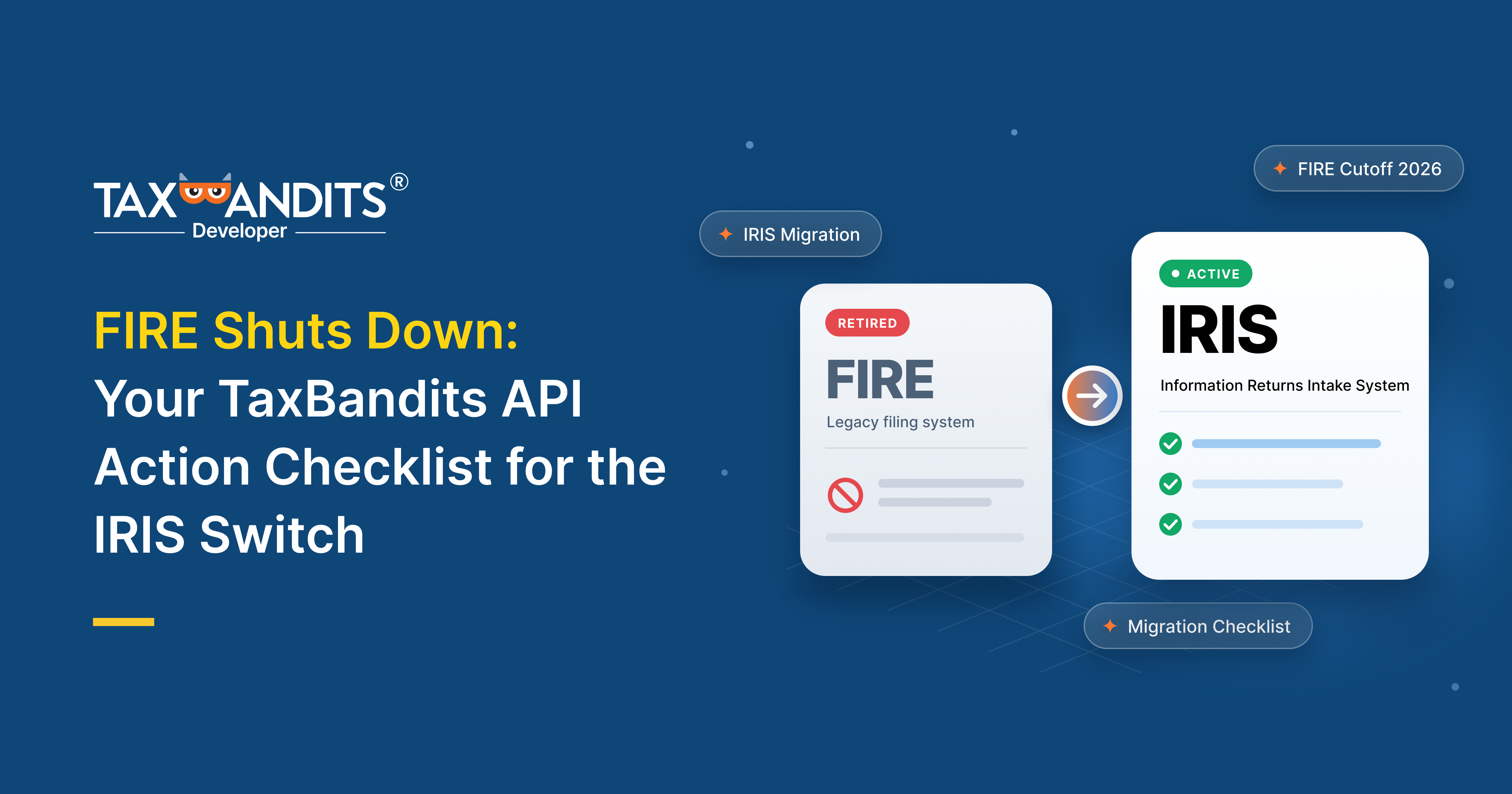
The IRS is retiring FIRE, the system it has used to receive information returns since the 1980s. If your integration files 1099s, 1098s, 5498s, or 1042-S through the TaxBandits API, this shift shows up in your code before it shows up on anyone's tax return.
This piece skips the history lesson. It focuses on what actually changes in your integration, how the TaxBandits API absorbs most of that work for you, and what you still need to do before the cutoff.
What's actually changing
FIRE stops accepting submissions on November 19, 2026, at 3 p.m. ET. Starting January 1, 2027, IRIS (the Information Returns Intake System) becomes the only electronic filing system for 1099s, 1098s, 5498s, 1042-S, and related forms, for current year, prior year, and corrections alike.
Inside the TaxBandits API specifically, the cutover happens earlier. Effective November 1, 2026, FIRE is no longer available through the API in either Sandbox or Live environments. From that date, IRSFilingType accepts only IRIS for supported information returns. If you set it to FIRE after the cutoff, the request throws an error.
The following forms and endpoints are unaffected and remain fully available on v1.7.3:
- Form W-2 — employer wage and tax statements
- 94x series (941, 940) — payroll tax returns
- ACA Forms (1095-B / 1095-C) — Affordable Care Act reporting
- Form W-9 / W-8 collection — TIN Matching, and all other non-1099 endpoints
Where this breaks your integration
Two things in a typical integration stop working, and neither announces itself until a request fails.
-
Hardcoded filing channel logic. If your code explicitly sets
IRSFilingType: FIRE, or branches on a filing channel anywhere in your submission flow, that logic needs to come out. After November 1, 2026, every information return routes to IRIS automatically. Leaving FIRE-selection logic in place doesn't just get ignored; it throws an error on the request. -
Combined name fields. FIRE accepted one string for a recipient's full name. IRIS wants first, middle, last, and business name as separate fields, matching how the IRS actually stores identity data. A recipient record with "John A Smith Jr" jammed into a single field won't validate until it's split.
How the TaxBandits API absorbs the switch
This is the part that actually saves you engineering time.
-
Early on IRIS validation
TaxBandits was one of the first authorized e-file providers to secure an IRIS A2A TCC, and its e-file engine has been built against IRIS validation rules since well before this cutoff. That means the platform isn't scrambling to adapt to IRIS now. The validation stack your submissions run through — TIN matching, field checks, schema rules has been live and tested against IRIS for a while.
-
No TCC application on your end
Filing directly through IRIS requires a Transmitter Control Code, and the IRS says that application can take up to 45 business days to process. TaxBandits already holds its own IRIS A2A authorization and files under it, so that wait doesn't sit on your critical path.
-
JSON in, IRIS XML out
Your integration keeps submitting JSON payloads through the same Create, Validate, Update, and Transmit workflow you already use. TaxBandits converts that JSON into IRS-compliant IRIS XML on its side. You don't touch a schema.
-
Handling returns already in progress
If your platform has 400 returns sitting in draft or pending status, still tagged
IRSFilingType: FIRE, when November 1 arrives, you don't need to touch them one by one. TaxBandits automatically converts any pending return still using FIRE to IRIS format on or after November 1, 2026.
If you'd rather control the timing yourself, for a specific batch or a specific client, you can call the Update endpoint and flip an eligible in-process return from FIRE to IRIS manually. -
Status you can actually act on
Once transmitted, every return comes back with one of three statuses: Accepted, Rejected, or Accepted with Errors. That third status usually means a TIN mismatch or a similar data issue rather than an outright rejection, and TaxBandits corrects those returns at no additional cost.
Best practices for the migration
A few habits make the difference between a clean cutover and a scramble in November.
-
Run Bulk TIN Matching before you migrate data, not after. IRIS validates TIN and name pairs at submission time. Under FIRE, a mismatch surfaced weeks later as a CP2100 notice. Under IRIS, it fails the request immediately. Clearing mismatches against your recipient roster now means fewer rejected submissions once you're live on IRIS.
-
Separate name fields before you need to, not when a request fails. Query your recipient database for combined name fields and split them into first, middle, last, and business name ahead of the deadline, rather than discovering the gap mid-filing-season.
-
Prefer webhooks over polling for status. FIRE's A-Record model meant writing your own polling and parsing logic. IRIS and the TaxBandits API surface status through webhook events instead. If your integration still polls, that's a good candidate to retire during this migration.
-
Test with both matching and mismatched TIN pairs in Sandbox. A test run that only uses clean data won't tell you how your integration handles an
Accepted with Errorsresponse. Test the failure path, not just the happy path. -
Remove FIRE logic everywhere it appears, not just in the main filing call. Teams often clean up the primary Create flow and forget that Update or resubmission paths reference the same filing-channel flag.
Dates that force your hand
| Date | What happens |
|---|---|
| November 1, 2026 | FIRE is no longer available via the TaxBandits API, in Sandbox or Live. Last day for FIRE test returns through the IRS Trading Partner Test System. |
| November 9, 2026 | Last day to change existing FIRE TCC applications. They become read-only afterward. |
| November 19, 2026, 3 p.m. ET | FIRE closes permanently across the IRS. No further submissions accepted. |
| January 1, 2027 | IRIS becomes the only IRS electronic filing system for information returns, including prior-year filings and corrections. |
Important: The IRS has confirmed no extensions and no grace periods for this shutdown.
Action items before November 1
- Search your codebase for
IRSFilingType: FIREand any filing-channel branching logic, and remove it. - Run Bulk TIN Matching against your full recipient roster and clear mismatches through W-9 requests.
- Separate any combined name fields into first, middle, last, and business name.
- Switch status handling from polling to webhook listeners.
- Decide whether to let pending FIRE returns auto-convert after November 1 or flip them manually via the Update endpoint.
- Run a full Sandbox test, including intentionally mismatched TINs, before requesting a Go Live review.
Get ahead of the cutoff
FIRE doesn't wait for a slow migration, and neither does the 2027 filing season. The TaxBandits Sandbox is free and available now at sandbox.taxbandits.com, so there's no reason to wait until October to find out what breaks.
Start your migration today: Log in to your TaxBandits developer account and run your first end-to-end IRIS test this week. If you get stuck on a specific payload or error code, TaxBandits support can walk through it with you before it becomes a filing-season problem.